
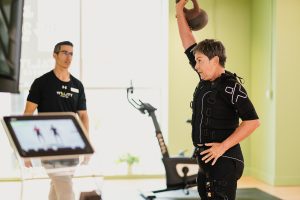
 Twenty minutes of exercise can sound implausibly short—especially in a fitness culture that still equates results with long workouts and exhaustion. Yet exercise science has been quietly dismantling the idea that longer always means better.
The real question is not how long you exercise.
It’s what physiological stimulus you create during that time.
Under the right conditions, 20 minutes can be enough to drive meaningful adaptations—particularly for strength and muscle activation. This is where electrical muscle stimulation (EMS) has been studied most closely.
Why Time Alone Is the Wrong Metric
Physiological adaptations are driven by stimulus quality, not duration in isolation. The primary drivers of training response include:
- Degree of muscle fiber recruitment
- Mechanical tension
- Metabolic stress
- Progressive overload
- Adequate recovery
Longer workouts can provide these inputs—but they are not the only way to do so. When a high-quality stimulus is delivered efficiently, adaptations can occur in much shorter sessions.
What EMS Does Differently
EMS works by delivering controlled electrical impulses through electrodes placed on the skin, causing muscles to contract involuntarily. This bypasses the usual voluntary recruitment pathway of the nervous system.
Why that matters:
During voluntary exercise, muscle fibers are recruited gradually, starting with lower-threshold fibers. EMS, by contrast, recruits a broader spectrum of muscle fibers simultaneously, including higher-threshold fast-twitch fibers that normally require heavy loads or near-maximal effort to activate.
This recruitment pattern is well documented in neuromuscular research and explains why EMS sessions are intentionally brief: the muscular stimulus is dense and fatiguing.
What the Research Shows About 20-Minute EMS Sessions
Strength and Muscle Activation
Multiple randomized controlled trials on whole-body EMS (WB-EMS) have demonstrated significant improvements in maximal strength with sessions lasting approximately 20 minutes, performed once or twice per week.
A frequently cited study by Kemmler et al. found that WB-EMS produced strength gains comparable to conventional resistance training, despite far lower total training time.
Source: Kemmler, W. et al. (2010). Journal of Strength and Conditioning Research.
Lean Mass and Time Efficiency
Follow-up research has shown increases in lean body mass using similar short-duration protocols. The authors explicitly identify time efficiency as a defining advantage of EMS-based training.
Source: Kemmler, W. & von Stengel, S. (2013). European Journal of Applied Physiology.
Reduced Joint Loading
EMG and biomechanical studies indicate that EMS can achieve high levels of muscle activation without the joint loading associated with heavy resistance training. This makes it particularly relevant for people returning after a break, managing joint limitations, or rebuilding capacity.
Source: Filipovic, A. et al. (2011). European Journal of Applied Physiology.
Where Cardio Fits In — and Where EMS Has Limits
This is an important distinction.
EMS is primarily a resistance and neuromuscular training modality.
It is not a universal replacement for all forms of exercise.
Cardiovascular adaptations—such as improved VO₂ max, stroke volume, and aerobic endurance—are most reliably achieved through sustained elevations in heart rate over time.
Can EMS Contribute to Cardio Fitness?
Research shows that WB-EMS can raise heart rate and metabolic demand, particularly when combined with dynamic movements or higher-intensity protocols. Some cardiovascular stimulus is present, especially in deconditioned individuals.
However, the scientific consensus is clear on one point:
EMS alone should not be relied upon as a primary method for developing cardiovascular endurance.
When cardio is the goal, explicit aerobic training is still required.
This is not a weakness of EMS—it’s simply a matter of matching the tool to the outcome.
Matching the Tool to the Goal
A practical way to think about this:
- Strength, muscle activation, efficiency: EMS is highly effective in short sessions
- Cardiovascular endurance and heart health: Dedicated cardio training is essential
- Overall fitness: A combined approach produces the strongest results
This aligns with broader research on concurrent training, which consistently shows that different physiological systems respond best to different stimuli.
How We Apply This at Vitality Fitness Studio
At Vitality Fitness Studio, EMS is used deliberately—for what it does best.
EMS sessions provide high-quality, time-efficient resistance training, particularly well suited for people restarting fitness, managing busy schedules, or seeking strength gains without excessive joint stress.
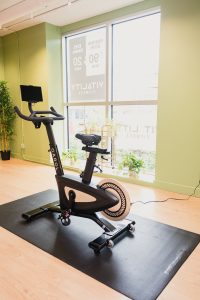
For cardiovascular conditioning, we pair this with dedicated aerobic training options, including the CAROL AI Bike, which is specifically designed to improve cardiovascular fitness using evidence-based, low-time-commitment protocols.
The goal is not a single “magic” solution, but a structured combination:
- EMS for neuromuscular strength and efficiency
- Cardio training for heart and endurance adaptations
Each element serves a clear physiological purpose.
So—Is 20 Minutes Enough?
Twenty minutes can be enough for specific outcomes, when the stimulus is appropriate and applied correctly.
The evidence supports EMS for:
- Strength development
- Muscle activation
- Time-efficient resistance training
Cardiovascular fitness still requires:
- Targeted aerobic stress
- Sustained heart-rate exposure
- Progressive endurance work
When these elements are combined intelligently, training becomes not just shorter—but smarter.
That’s not a shortcut.
That’s science applied with intention.
